
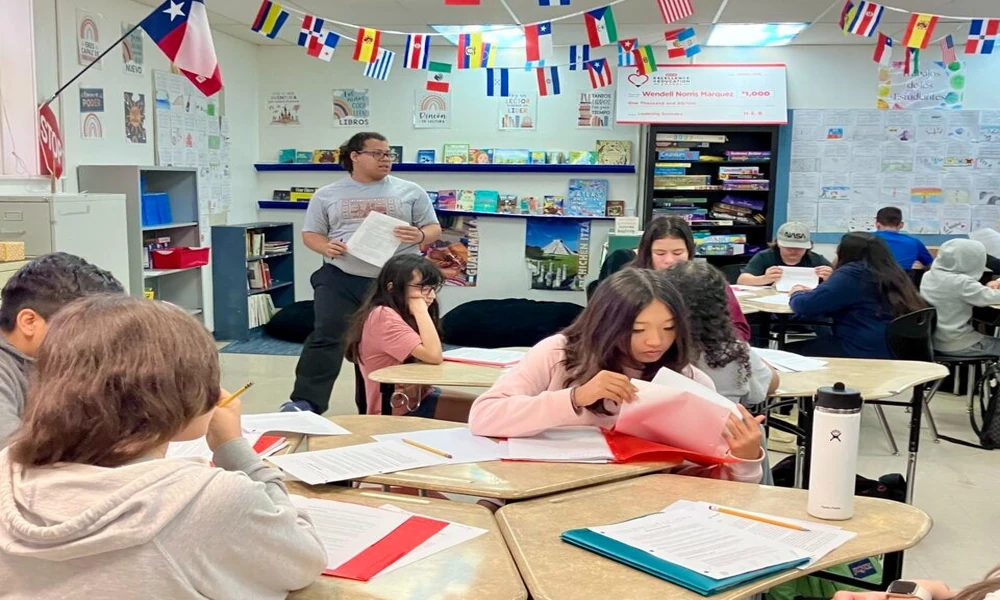
How an effective middle-school Spanish program can move students beyond memorization and toward real communication
A strong Spanish for middle school program should do more than teach students how to memorize vocabulary lists and conjugate verbs for a quiz. Middle school is a particularly useful stage for language learning because students are developing stronger reading, writing, listening, and analytical skills while also becoming more independent learners.
The most effective programs use that stage of development to connect Spanish with communication, culture, and situations students can actually imagine themselves experiencing.
What Makes Middle School Spanish Different?
Middle school students are not simply younger high school students. They need instruction that matches their developmental stage.
Students may be capable of understanding grammar rules, but they also benefit from movement, conversation, games, visual material, short challenges, and meaningful projects. A successful program balances structure with opportunities to use the language.
Instead of introducing a long vocabulary list such as food, clothing, or school supplies and stopping there, teachers can build a scenario around it. Students might role-play ordering food, describe what they would pack for a trip, or create a short Spanish-language school schedule.
Start With Communication, Not Perfection
One of the biggest barriers for adolescent language learners is fear of making mistakes. If every activity feels like a test, students may become reluctant to speak.
A practical middle school program should give students low-pressure opportunities to communicate. Simple exchanges such as greetings, introductions, preferences, descriptions, and questions can become progressively more complex.
For example, students can move from:
“Me gusta el fútbol.”
to:
“Me gusta el fútbol porque es divertido.”
and eventually:
“Me gusta el fútbol porque me permite pasar tiempo con mis amigos.”
The goal is not to eliminate mistakes immediately. It is to help students become increasingly comfortable expressing meaning.
Build Vocabulary Around Real Situations
Vocabulary is easier to remember when students have a reason to use it.
An effective Spanish for middle school program can organize vocabulary around situations such as:
- Introducing yourself and talking about family
- Describing school life
- Ordering food at a restaurant
- Discussing hobbies and weekend activities
- Asking for directions
- Talking about weather and seasons
- Planning a trip
- Describing daily routines
- Talking about preferences and opinions
These topics give students repeated exposure to useful words while providing natural opportunities to practice sentence structure.
Grammar Should Support Communication
Grammar still matters, but it works best when students understand why they are learning it.
Instead of presenting a full chart of verb conjugations without context, teachers can introduce a small set of verbs through meaningful communication. Students can use “tener” to describe what they have, “gustar” to discuss preferences, or common present-tense verbs to explain their daily routines.
As students become comfortable, the program can introduce more complex structures.
This approach makes grammar a tool rather than the entire lesson.
Culture Should Be Part of the Language
Spanish is spoken across many countries and communities. A middle school program should reflect that diversity instead of presenting Spanish-speaking cultures as a single, uniform experience.
Students can explore music, food, holidays, geography, sports, art, architecture, and everyday life from different Spanish-speaking regions. The important point is to connect cultural material to language use.
For example, a lesson about food can introduce regional dishes while students practice ordering, describing ingredients, comparing preferences, and discussing meals.
Project-Based Learning Can Increase Engagement
Middle school students often respond well when they have something tangible to create.
Projects might include a Spanish travel guide, a mock restaurant menu, a short video introduction, a digital postcard, a family or community profile, or a presentation about a Spanish-speaking city.
Projects also make assessment more authentic because students demonstrate what they can do with the language rather than simply recalling isolated facts.
What Parents and Schools Should Look For
When evaluating a Spanish for middle school program, look for a curriculum that provides:
- Regular speaking and listening practice
- Reading and writing at an age-appropriate level
- Clear progression from beginner skills to more complex communication
- Cultural learning integrated with language instruction
- Activities that encourage participation without making students afraid of mistakes
- Meaningful assessments and projects
- Consistent opportunities to review previously learned language
A good program should also make progress visible. Students should be able to recognize what they can now understand, say, read, and write in Spanish.
Conclusion
The strongest Spanish for middle school program is one that treats language as a skill students use-not just a subject they study. By combining communication practice, useful vocabulary, purposeful grammar, cultural context, and engaging projects, schools can give students a stronger foundation for continued Spanish study.
For families and educators comparing programs, the key question is simple: will students leave the classroom knowing more Spanish, or will they also feel more confident using it?